
Culture & Heritage
Your First Chinese Temple Visit: Etiquette and Photo Rules
Incense, kneeling and photos: the practical etiquette rules for your first visit to a Chinese temple, from which door to enter to when to stop shooting.
Manjing Travel
Published 7 min read
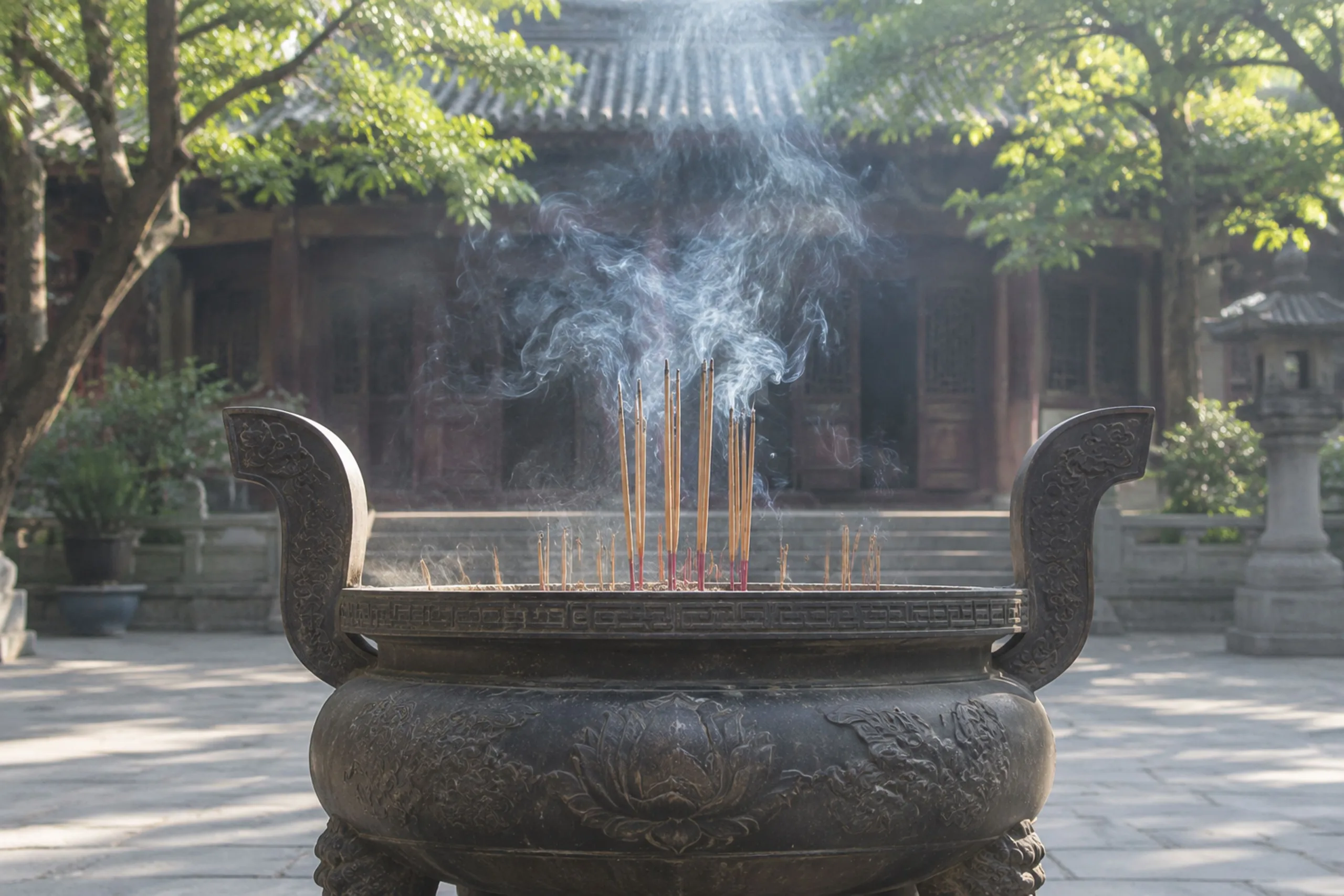
01
First, figure out what kind of place you’ve walked into.
Chinese temples are neither museums nor stage sets. They are authentic religious spaces where people come to unburden themselves of sorrow, express gratitude, make vows, or seek assistance.
While Buddhist temples (*si*) and Taoist temples (*guan*) share many ritual practices, they are not identical. Buddhist halls center on the Buddha and the monastic community, whereas Taoist temples may enshrine the Jade Emperor, Laozi, or local deities; furthermore, the gesture used for paying respects in Taoist settings involves cupping one’s hands (*baoquan*) rather than pressing one’s palms together (*heshi*). Many sites in China are "hybrid" in nature—for instance, a Buddhist temple complex might house a side hall dedicated to Taoism—so the safest approach is always the same: observe first, and then emulate only those practices that are clearly open to you.
02
Before You Leave: What to Wear and What to Pack
Chinese temples are generally more relaxed than those in some parts of Southeast Asia—you are rarely stopped or questioned—but dressing thoughtfully is the quickest way to show respect.
Recommended attire:
Tops with sleeves, along with long trousers or skirts that fall below the knees.
Footwear that is flat, quiet when walking, and easy to remove (as some temple halls require you to take off your shoes).
Loose, comfortable clothing—it can sometimes feel cool inside temple buildings, even in the summer.
Avoid wearing—or ensure you cover up—the following:
Tank tops, crop tops, shorts, or miniskirts
Hats or sunglasses (if still worn after entering the temple)
Flip-flops (which make a loud slapping sound against the stone floor)
Clothing featuring offensive slogans or imagery
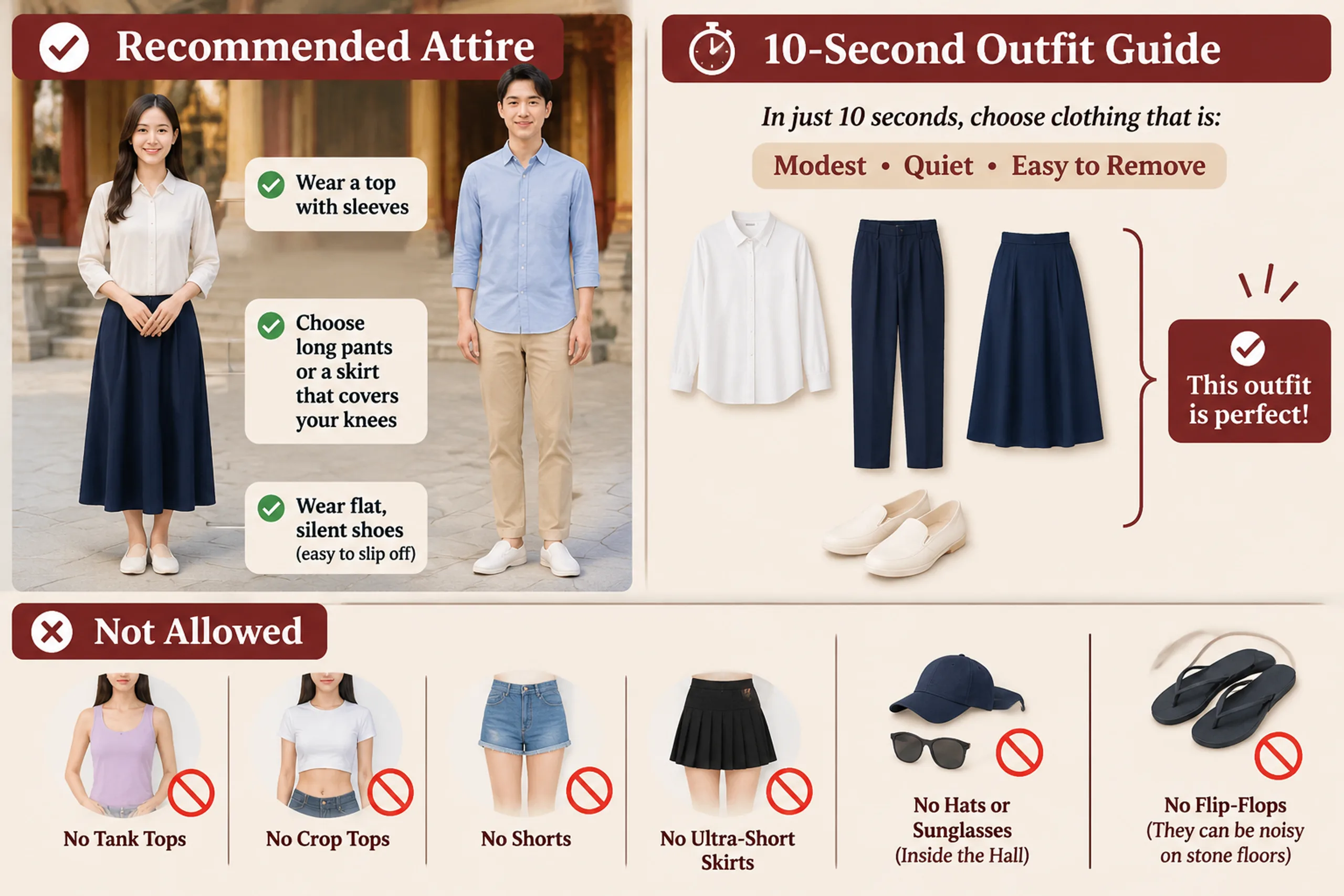
Keeping a lightweight scarf in your bag is very practical; if you happen to be wearing a sleeveless top, you can simply drape it over your shoulders. It’s also a good idea to carry a small amount of cash (10–50 yuan) for entrance fees or temple donation boxes—though nowadays, most temples also accept payments via WeChat, Alipay, or dedicated booking apps. Before entering, be sure to set your phone to silent; a ringing phone can be highly disruptive during prayers.
03
The Mountain Gate: Thresholds, Doorways, and the Direction of Movement
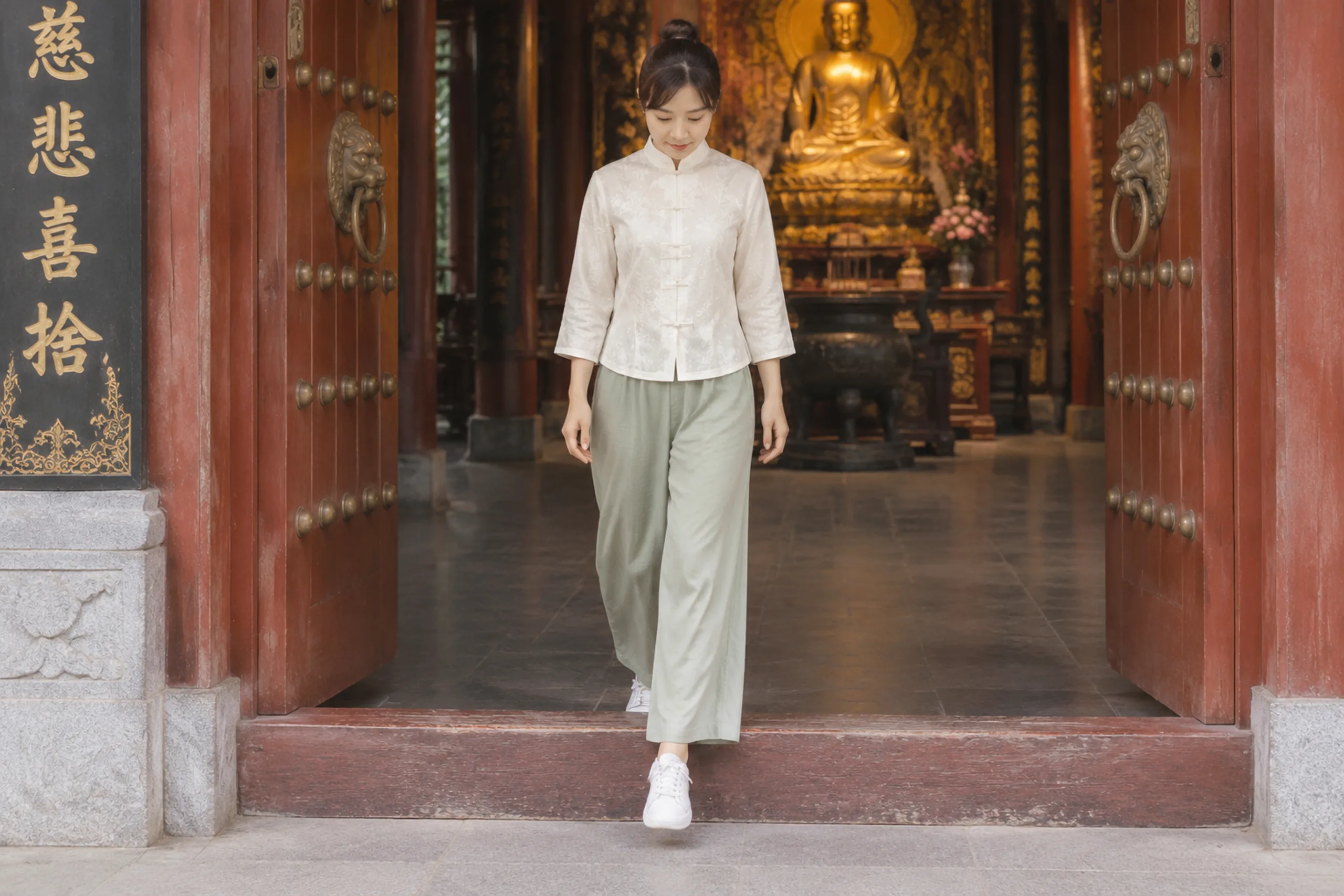
Use the side entrances. Traditional temple gates feature three openings; the central one—known as the "gate of emptiness"—is symbolically reserved for the Buddha, the abbot, or ceremonial processions. As a visitor, you should enter through one of the side gates and exit through another. If a temple has restricted access and only the central gate is open, simply follow the flow of the crowd.
Step over the threshold—never step on it. The raised wooden or stone threshold at a doorway is considered the boundary of a sacred space; stepping on it is regarded as a sign of disrespect.
Keep to the left and move in a clockwise direction. When navigating courtyards or halls, it is customary for worshippers to move in a clockwise direction. Follow the flow of the crowd and stay toward the sides of the main paths; avoid walking directly through the middle of people who are kneeling in prayer.
Do not turn your back on the altar. After paying your respects, if you are close to the front, take a few steps backward or to the side before turning to leave. If a religious ceremony is underway, either stand to the side to observe quietly or slip away discreetly—never walk through the middle of a group of people who are praying.
04
Offering Incense: The Ritual Tourists Most Often Get Wrong
Obtain incense within the temple grounds. Most temples provide three sticks for free or for a nominal fee. Three is the standard number—in Buddhism, it represents the "Three Jewels" (the Buddha, the Dharma, and the Sangha), while in Taoism, it represents Heaven, Earth, and Humanity.
Light the three sticks of incense at a designated flame source, holding them together.
If there is an open flame on the incense tips, do not blow it out with your mouth. Instead, gently fan the flame out with your hand or shake the sticks until the tips glow red. Traditionally, it is believed that the breath from one’s mouth is "impure"; practically speaking, in a crowded and smoky temple courtyard, fanning the flame is also the safer method.
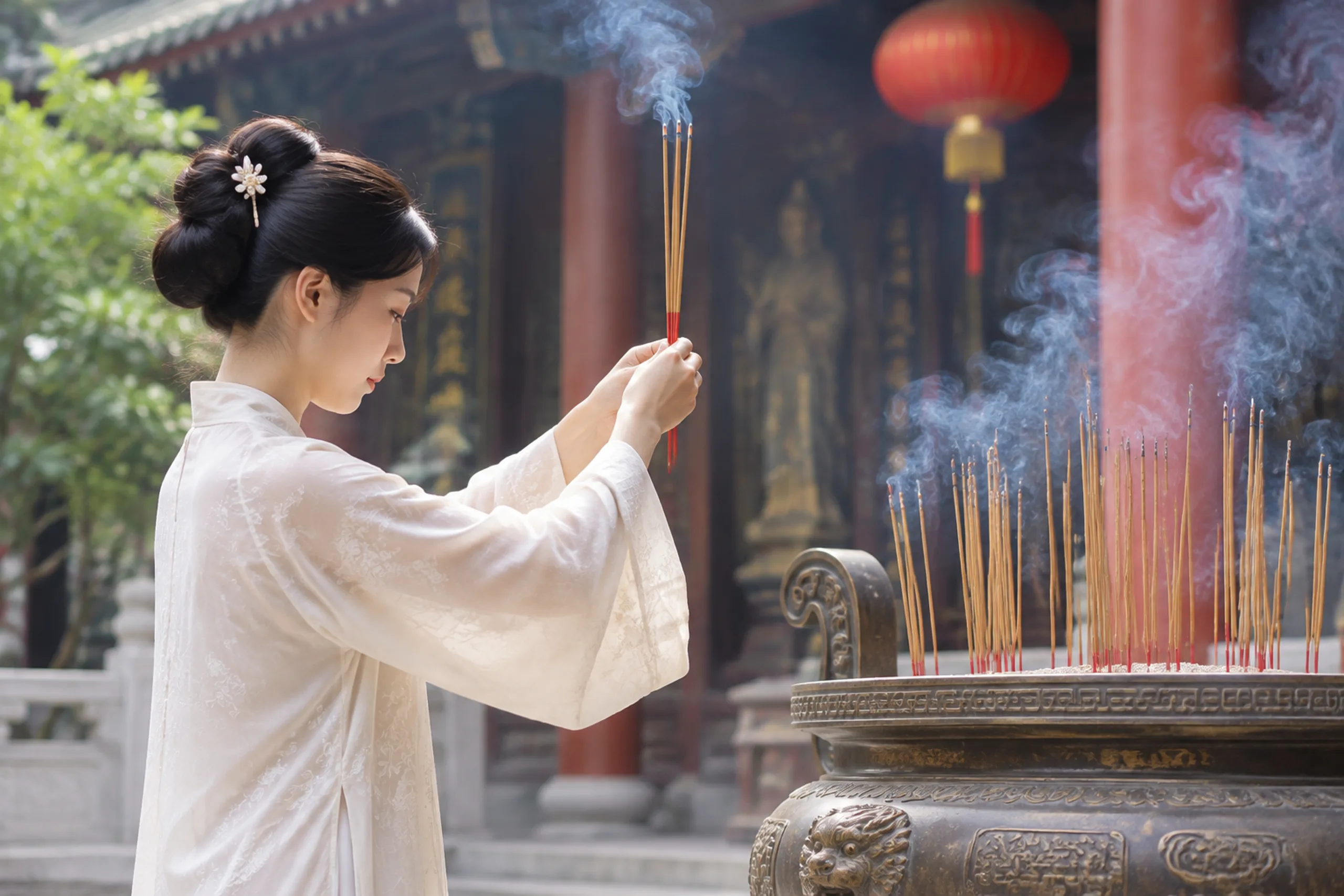
Hold the three sticks upright with both hands, positioned in front of your forehead or chest. Face the main hall and stand quietly to make a wish or offer a prayer of gratitude—there is no need for a formal, set prayer.
Perform three bows, then place the incense sticks—one by one—upright into the ash of the large incense burner, keeping them close together. Do not toss them in, and do not force them into a burner that is already full; if necessary, take a step back or ask the temple staff where to place them.
Take a step back, then depart calmly.
05
Kneeling and Bowing: Points to Keep in Mind
If you wish to perform an act of prostration or prayer within ten seconds, you may simply bow, bow with your hands pressed together, or kneel on a prayer mat to offer your respects.
Practical Reminders:
In a crowded hall, please do not occupy a prayer mat merely to rest or take photographs.
The prayer mat in the center of the hall is traditionally reserved for the abbot or the presiding officiant; please use the mats on either side instead.
Remove your hat and sunglasses before entering the hall; do not touch the Buddha statues or ritual implements.
If you are unsure whether those around you are praying or simply visiting, follow their lead. Sincerity of heart is far more important than the precision of your actions.
06
Photography: What You Can and Cannot Photograph
This is the area most prone to misunderstanding, as the rules vary not only from one temple to another but even between different halls within the same temple.
Usually, it’s possible.
Courtyards, gardens, exteriors, and temple gates
Photographing architecture from a distance
Wide-angle shots that do not center on Buddhist statues
Designated outdoor "photo zones"
Generally not permitted.
Inside the main hall, especially near the altar
Close-up shots of Buddha statues or other religious icons
Photographing monks, staff members, or people in prayer
As a foreign tourist, am I required to offer incense or pray?
No. Both are entirely voluntary. Standing quietly with palms pressed together—or simply observing—is also a form of respect. If you do not intend to offer incense, then do not touch it.
Can you wear shorts or skirts in a temple?
It’s best to avoid them. Keep your shoulders and knees covered; if you happen to be underdressed, a scarf from your bag can serve as a quick fix.
Can I take photos of Buddha statues?
Generally, this is not permitted inside the main hall; even where photography is otherwise allowed, close-ups of Buddha statues are often prohibited. Check for signage, never use a flash, and if you’re unsure, ask a staff member. Photography in the courtyards and of the building’s exterior is almost always fine.
When are temples most crowded?
Temples see large crowds during the Spring Festival, the first and fifteenth days of the lunar month, and other major holidays; during these times, some temples may require advance reservations or restrict the burning of incense. Weekday mornings are the quietest times to visit. When planning your trip, you may want to consult our guide to Chinese public holidays and the best times to travel.
Is it worth planning a trip around temples?
Many travelers combine temple visits with other cultural attractions—such as the Buddhist art in Dunhuang or the sacred sites in Lhasa. While the principles of etiquette are generally consistent, there are subtle regional variations.
Published 2026-11-23 by Manjing Travel.
Still have a question this did not answer?
A named planner replies within one working day. No call centre and no chatbot.
Ask a planner